A memory game using letters and pictures is a simple, creative, and educational activity that can help children develop memory, concentration, vocabulary, reading, and observation skills. The game combines colorful pictures with letters or words and turns learning into an enjoyable challenge. Instead of simply studying letters from a book, children can look at cards, remember their positions, find matching pairs, and say the correct letter or word.
This activity can be made easily from cardboard, paper, recycled packaging, or craft materials. It does not require expensive equipment, and it can be adapted for children of different ages. Younger children can match a letter with a picture, while older children can match pictures with complete words or practice vocabulary in another language.
The memory game can be played at home, in a classroom, at a library, or during a school activity. It is especially useful for early education because children learn naturally through repetition, movement, and play.
What Is a Letter and Picture Memory Game?
A letter and picture memory game is a matching activity made from pairs of cards. Each card contains either a letter, a word, or a picture.
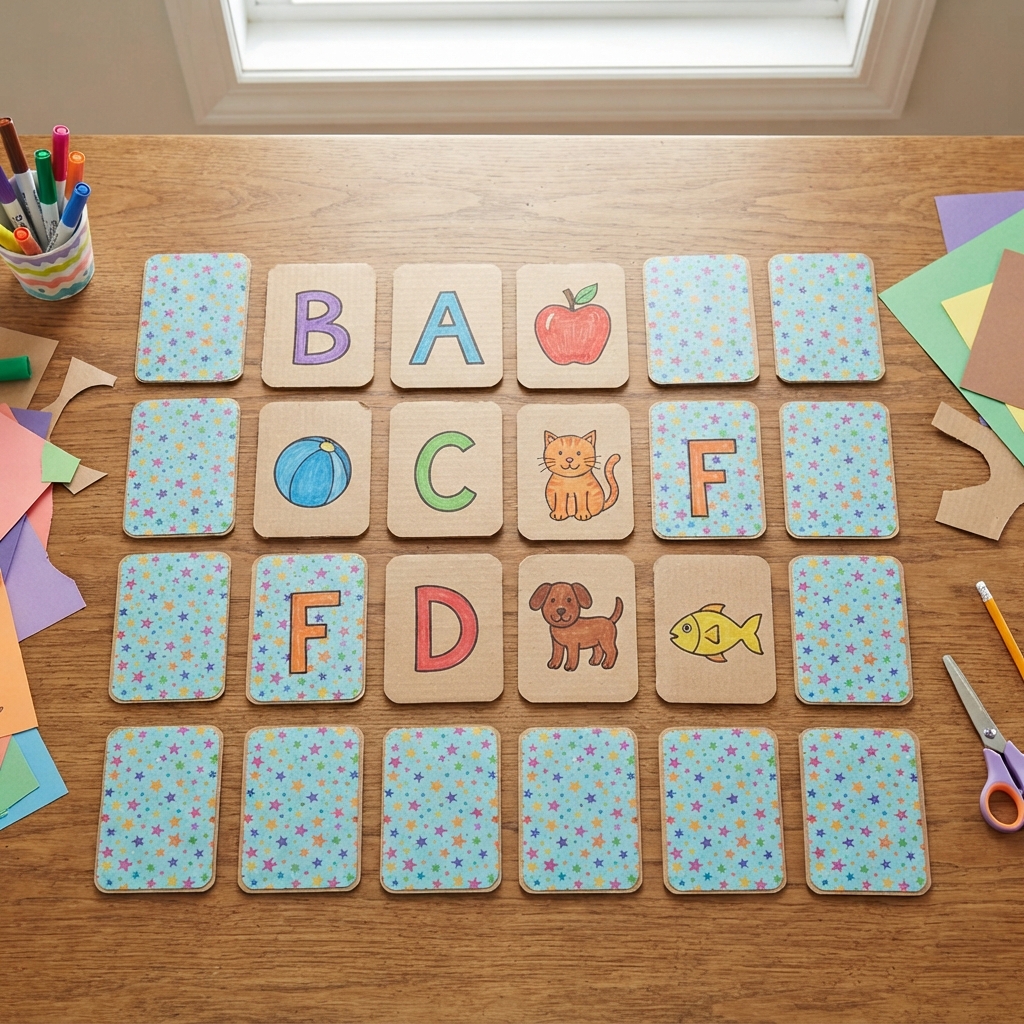
The basic idea is to place all the cards face down. Players take turns turning over two cards at a time. If the cards form a correct pair, the player keeps them. If they do not match, the cards are turned face down again.
For example, one card might show the letter B, while another card shows a picture of a ball. The player must remember where the two cards are located and eventually match them.
Another version can use the letter C and a picture of a cat. This helps children connect letters with sounds and vocabulary.
Why Is This Game Educational?
The game provides more than entertainment. It encourages children to remember information and pay close attention to details.
When children turn over cards, they must remember where they saw a particular letter or picture. This exercises memory.
The game also develops visual recognition. Children learn to notice differences between letters, colors, shapes, and pictures.
At the same time, saying the letter and identifying the picture helps strengthen vocabulary and language development.
Because children are playing, they may practice these skills repeatedly without feeling that they are doing difficult schoolwork.
Materials Needed
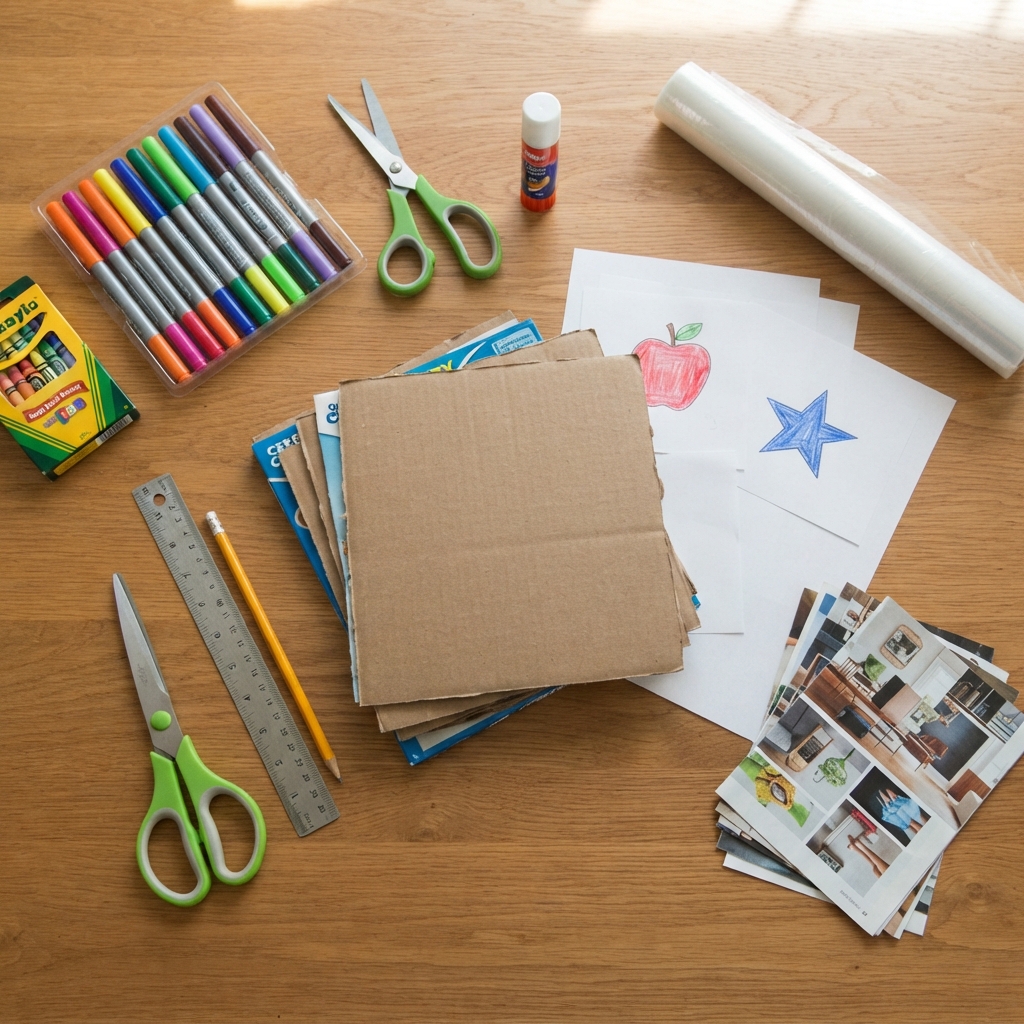
The materials for the game are simple.
You need thick paper or cardboard, scissors, a ruler, a pencil, colored markers, crayons, and glue.
Old cereal boxes or other clean cardboard packaging can be recycled for the cards.
Printed pictures can be used, or children can draw their own pictures.
A laminating sheet or clear adhesive film is optional. It can make the cards stronger and easier to clean.
The number of cards depends on the age of the children. Beginners can start with six or eight cards, while older children can use twenty or more.
Designing the Cards
The cards should be approximately the same size.
For example, each card could be a small square or rectangle.
The backs of all cards should look the same. This is important because players should not be able to identify a card by its back.
The front of each card can contain a large letter, a word, or a colorful picture.
Letters should be written clearly and in a large font.
Pictures should be simple enough for children to recognize quickly.
Creating Letter Cards
Letter cards can contain uppercase letters, lowercase letters, or both.
For beginners, uppercase letters are often easier to recognize.
The cards can include letters such as A, B, C, D, and E.
As children become more confident, more letters can be introduced.
A teacher can also focus on specific letters that students are currently learning.
For example, a lesson about the letter M could include several pictures beginning with the /m/ sound, such as moon, monkey, and milk.
Creating Picture Cards
Picture cards can show familiar objects, animals, foods, and school supplies.
Examples include:
- Apple
- Ball
- Cat
- Dog
- Fish
- Sun
- Tree
- Book
Children can draw these pictures themselves.
Hand-drawn pictures are especially valuable because creating them becomes part of the learning activity.
The pictures should be clear and recognizable.
Making Matching Pairs
The most important step is deciding which cards belong together.
A letter card should have a corresponding picture card.
For example:
A → Apple
B → Ball
C → Cat
D → Dog
F → Fish
This creates a simple connection between the letter and the beginning sound of the word.
For older children, the letter card can be replaced with a word card.
For example:
BUTTERFLY → picture of a butterfly
This makes the activity more challenging.
Preparing the Game
Once all the cards are finished, mix them together.
Place them face down on a table or classroom floor.
The cards can be arranged in rows and columns.
Make sure there is enough space between them so that children can easily turn them over.
The first player chooses any two cards and turns them face up.
Everyone looks at the cards.
If they match, the player keeps them and takes another turn.
If they do not match, both cards are returned to their original positions.
The next player then takes a turn.
The Importance of Memory
The memory element is what makes the game exciting.
When a player sees a card that does not match the first card, they still gain useful information.
They remember the location of that card.
Later, if they find its matching partner, they can remember where the first card was located.
For example, a child may turn over the letter B and a picture of a tree. They know the cards do not match, but they remember that the tree is in a particular position.
Several turns later, they may discover the picture of a ball and remember where the letter B was.
This develops memory through repeated observation.
Learning Letter Sounds
The game can be used to teach phonics.
When a child finds the letter B and the picture of a ball, the teacher can ask the child to say the beginning sound.
The child can repeat the sound several times.
The same method can be used with other letters.
For example, the letter S can be matched with a picture of a sun.
This helps children understand that letters represent sounds used in spoken words.
Learning Vocabulary
The game can also introduce new vocabulary.
A teacher can choose pictures that represent words students are learning.
When a child finds a pair, they say the word aloud.
The teacher can ask a simple question about it.
For example, after matching a picture of an elephant, the child might be asked:
“Where does an elephant live?”
or
“What color can an elephant be?”
This turns a simple matching activity into a broader conversation.
Using the Game for Spelling
Older children can use the game to practice spelling.
Instead of matching a single letter with a picture, children can match a complete word with its picture.
For example:
ELEPHANT → picture of an elephant
BUTTERFLY → picture of a butterfly
SCHOOL → picture of a school
After finding the pair, the student can spell the word aloud.
This combines visual memory with spelling practice.
Learning a Foreign Language
The memory game is especially useful for learning another language.
One card can contain a picture, while its matching card contains the foreign-language word.
For example, a picture of a cat can be matched with the word chat in French.
A picture of a house can be matched with the appropriate word in the language being studied.
Students can say the word aloud after finding each pair.
This creates repeated exposure to new vocabulary.
Increasing the Difficulty
The game can become more challenging as children improve.
One method is to increase the number of cards.
Another is to use similar-looking pictures.
Teachers can also use longer words.
A more advanced version can require students to match a picture with a definition instead of a simple word.
For example, one card might show a picture of a thermometer, while the matching card says, “An instrument used to measure temperature.”
This turns the game into a vocabulary and comprehension exercise.
Playing in Teams
The memory game can be played in teams.
Students can work together to remember where cards are located.
One student turns over the cards while teammates discuss possible matches.
Team play encourages communication and cooperation.
It can also help students who are less confident because they can receive support from classmates.
The teacher can emphasize that the goal is learning and teamwork rather than simply winning.
Using the Game in the Classroom
A teacher can use the memory game as part of a regular lesson.
For example, after introducing a new group of vocabulary words, the teacher can create matching cards using those words.
At the end of the lesson, students play the memory game to review what they have learned.
The game can also be used at the beginning of the next lesson as a quick revision activity.
Because the cards are reusable, they can be stored and used many times.
Creating a Themed Memory Game
The game can be designed around a specific theme.
A school-themed game might include pictures of books, pencils, rulers, desks, bags, and classrooms.
An animal-themed game could include cats, dogs, lions, elephants, birds, and fish.
A nature-themed game might include flowers, trees, clouds, mountains, and the Sun.
Themed games help children learn vocabulary in groups.
Making the Cards Attractive
Color and design can make the game more appealing.
Children can decorate the card borders with simple patterns.
However, the designs should not be too complicated.
The main information—the letter, word, or picture—should remain easy to see.
Different themes can use different border designs.
For example, an animal game could have paw prints around the edges, while a school game could have tiny pencils and books.
Educational Benefits
The memory game supports several important skills.
It strengthens memory because children must remember the locations of cards.
It improves concentration because players need to observe carefully.
It develops language skills through letter recognition, pronunciation, vocabulary, and spelling.
It also develops fine motor skills because children pick up and turn over cards.
In addition, the game teaches patience and turn-taking.
Children learn to wait while others play and follow simple rules.
Encouraging Independent Learning
Children can eventually play the game without constant adult assistance.
Once they understand the rules, they can organize the cards, play with a partner, and check their own matches.
This encourages independence.
Older children can even design new cards and create their own games.
They can choose the theme, draw the pictures, write the words, and decide which cards should match.
This transforms the activity into both a learning game and a creative project.
Recycling Benefits
The memory game is also a good recycling project.
Cardboard from packaging can become durable game cards.
Old magazines can provide pictures.
Unused paper can become card decorations.
By reusing materials, children learn that objects that seem useless can become something valuable.
This can encourage creative thinking and environmental responsibility.
Safety Tips
Children should use scissors carefully and follow age-appropriate safety rules.
Adults can help younger children cut cardboard.
Small cards should be kept away from very young children because they may be a choking hazard.
The workspace should be clean and organized.
If adhesive materials or laminating equipment are used, children should follow adult guidance.
Conclusion
A memory game using letters and pictures is a simple but powerful educational activity. It combines play, language, visual recognition, memory, and creativity in one enjoyable project.
The game can begin with very simple letter-and-picture pairs for young children. As students become more confident, it can develop into a more advanced activity involving complete words, spelling, definitions, sentences, and foreign-language vocabulary.
The materials are inexpensive and easy to find. Cardboard, paper, markers, scissors, and pictures are enough to create a complete game. Recycled materials can make the project even more environmentally friendly.
The activity can be played at home or in school, individually or with groups. Children learn to remember locations, recognize letters, connect sounds with pictures, build vocabulary, and communicate with their classmates.
Most importantly, the memory game demonstrates that education can be both effective and enjoyable. Children do not simply memorize information; they actively search, observe, remember, match, and solve problems.
With colorful pictures, clear letters, and a little imagination, a simple collection of cardboard cards can become an exciting learning tool. A letter and picture memory game can help children build important academic and social skills while giving them an opportunity to learn through play.