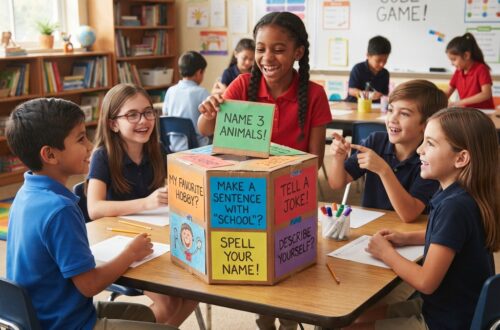
A word shooting game is a fun, interactive, and educational activity that combines learning with movement and play. Instead of asking children to memorize vocabulary from a book, the game turns words into an exciting challenge. Players can “shoot” or knock down target words using safe classroom materials such as paper balls, foam balls, beanbags, or toy-safe pointers. The goal is to identify, match, read, spell, or recognize the correct word.
Word shooting games can be adapted for children of different ages and learning levels. They can be used to practice letters, phonics, spelling, vocabulary, sight words, grammar, foreign-language words, or even simple sentences. Because the activity involves both physical movement and mental concentration, it can help children stay interested and participate actively.
Most importantly, a word shooting game does not need expensive equipment. Teachers and parents can make the targets from cardboard, paper cups, paper plates, or recycled boxes. With a few markers and some creativity, an ordinary classroom can become a playful learning environment.
What Is a Word Shooting Game?
A word shooting game is an educational game in which words are placed on targets, and players try to hit the correct target according to a question or instruction.
For example, a teacher may place ten paper cups on a table. Each cup has a different word written on it. The teacher says, “Find the word apple.” The student then throws a soft ball toward the cup labeled “apple.”
Another version can involve spelling. The teacher says a word, and the child must hit the letters needed to spell it.
The word “shooting” in this type of activity refers to aiming at a target with a safe object. It should not involve real weapons or dangerous equipment. The activity is designed for learning and should always use child-safe materials.
Why Is the Game Useful?
Traditional vocabulary exercises can sometimes become repetitive. Children may lose concentration when they repeatedly copy words or complete worksheets.
A word shooting game introduces movement and competition. Children must listen carefully, think quickly, identify the correct word, and aim at the target.
The combination of physical activity and learning can make lessons more memorable.
The game can also encourage shy students to participate. Because the activity feels like a game rather than a formal test, children may feel more comfortable trying.
Materials Needed
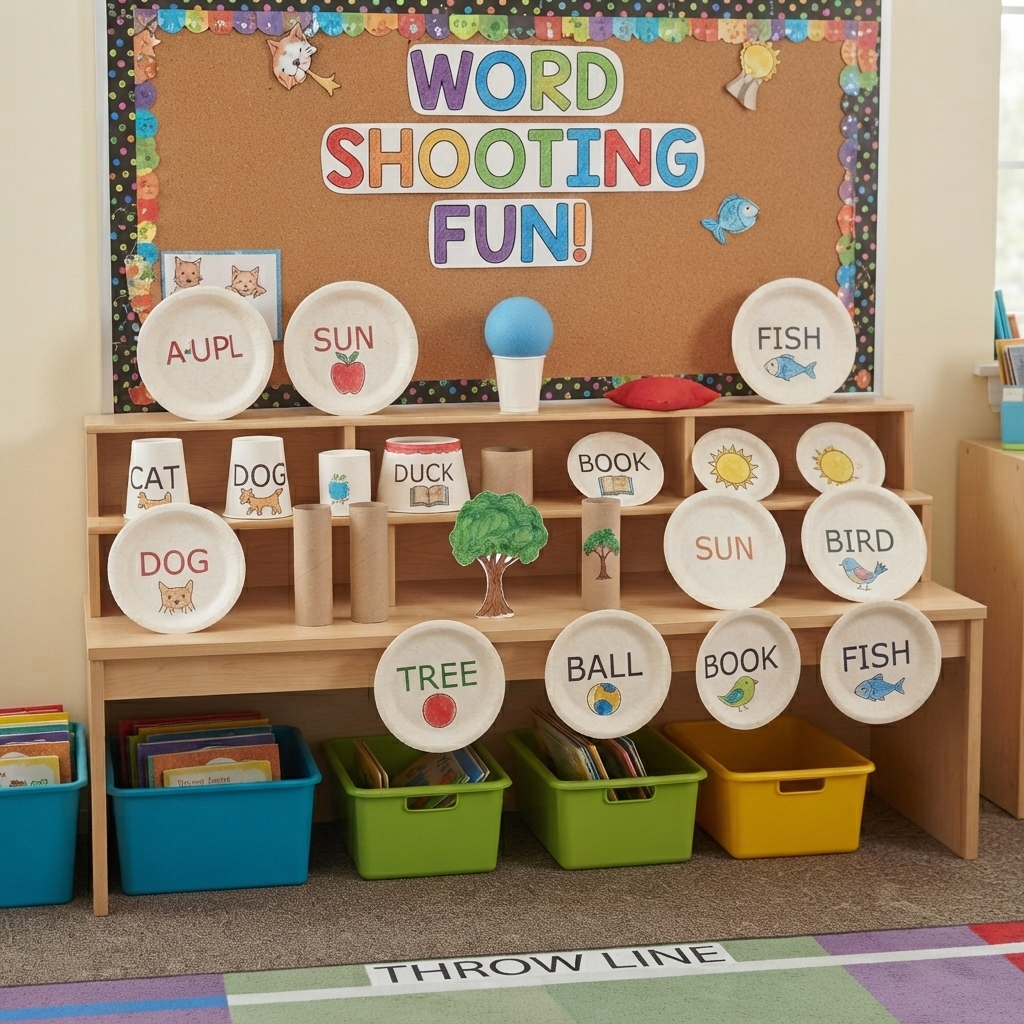
A basic word shooting game requires only a few materials.
Useful supplies include paper, cardboard, markers, paper cups, soft foam balls, beanbags, or crumpled paper balls.
Teachers can also use recycled cereal boxes or cardboard packaging to create targets.
For older students, small cards can be attached to a wall or board. For younger children, large colorful targets are easier to see.
The materials should always be lightweight and safe.
Making the Targets
Making the targets is one of the easiest parts of the project.
Paper cups can be arranged in rows, with one word written on each cup. Alternatively, words can be written on cardboard circles.
Paper plates can become large targets. Several sections can be drawn on each plate, and different words can be placed in the sections.
Another option is to make standing targets from cardboard boxes. Each box can contain a different word.
The targets can be decorated with colorful borders, numbers, stars, or simple pictures.
Choosing the Words
The words should match the children’s age and learning level.
For beginning readers, simple words such as “cat,” “dog,” “sun,” “book,” and “tree” are suitable.
For spelling practice, teachers can choose words that contain the sounds or letter combinations currently being studied.
Older students can practice more advanced vocabulary.
The game can also be used for foreign-language learning. Words in one language can be placed on targets, while the teacher gives the translation in another language.
Playing the Basic Game
The basic version is simple.
First, place the word targets in a safe location. Give the player a soft ball or beanbag.
The teacher or game leader calls out a word.
The player listens carefully, finds the matching target, and aims at it.
If the player hits the correct target, they receive a point.
If they hit the wrong target, they can try again or allow another player to take a turn.
The rules can be adjusted depending on the age and ability of the participants.
Word Recognition Version
A word recognition game is ideal for young children who are learning to read.
Several words can be displayed on large cards.
The teacher says one word aloud.
The child must identify the correct card and hit it with a soft ball.
For example, if the cards show “fish,” “tree,” “car,” and “house,” the teacher may say “fish.”
The child looks at the cards, identifies “fish,” and aims at that target.
This activity helps children connect spoken words with written words.
Picture and Word Matching
Pictures can make the game easier for younger learners.
A picture can be placed on one target while the matching word appears on another.
For example, one target can show a picture of an apple, while another target says “apple.”
The teacher asks the child to hit the word that matches the picture.
This activity develops vocabulary and reading comprehension at the same time.
Spelling Game
A word shooting game can also be used to practice spelling.
Individual letters can be written on separate targets.
The teacher gives a word, such as “CAT.”
The player must hit C, A, and T in the correct order.
This version can be played individually or in teams.
It encourages children to think about letter order while also practicing coordination.
Phonics Game
Phonics is another excellent area for this activity.
Teachers can write individual sounds or letter combinations on the targets.
For example, targets could contain “sh,” “ch,” “th,” “oo,” and “ee.”
The teacher says a word and asks students to identify the sound they hear.
For example, the word “ship” contains the “sh” sound. The student aims at the “sh” target.
This makes phonics practice more active and memorable.
Sight Word Game
Sight words are commonly used words that children learn to recognize quickly.
A teacher can write sight words on several targets, such as “the,” “and,” “you,” “is,” “can,” and “we.”
The teacher calls out a word, and the student tries to hit it.
As students become more confident, the number of targets can be increased.
A timer can also be introduced for an additional challenge.
Vocabulary Challenge
Older children can use the game to learn new vocabulary.
The targets can contain advanced words.
The teacher gives definitions rather than saying the word directly.
For example, if the target says “enormous,” the teacher might say, “Which word means very large?”
The student must think about the definition before choosing the correct target.
This changes the activity from simple word recognition into a vocabulary and comprehension exercise.
Synonym and Antonym Game
Synonyms and antonyms can also be practiced.
Several words are placed on targets.
The teacher says, “Find a synonym for happy.”
The student might choose “joyful” or another appropriate word.
For antonyms, the teacher might say, “Find the opposite of hot.”
The player must identify the correct target.
This version is especially useful for language classes.
Grammar Game
Words can also be used to practice grammar.
Targets can contain nouns, verbs, adjectives, and adverbs.
The teacher asks students to identify a specific type of word.
For example, the teacher might say, “Hit the verb.”
The student chooses a target containing a verb.
Another version asks students to identify the correct word for completing a sentence.
For example, “The cat ___ quickly.” Targets might include “runs,” “blue,” and “table.”
The student should hit “runs.”
Team Competition
A word shooting game can become a team activity.
Students can be divided into two or more groups.
Each team takes turns answering questions and aiming at targets.
A correct hit earns one point.
The team with the most points at the end wins.
Team games encourage cooperation and communication. Students can help teammates think about the correct answer before the shot.
Timed Challenge
A timer can make the activity more exciting for older students.
The player has a limited amount of time to identify and hit as many correct words as possible.
For example, the player might have thirty seconds to hit five vocabulary targets.
The teacher can record the score and repeat the activity later to see whether the student improves.
The timer should not create excessive pressure, especially for younger children.
Creating a Classroom Version
A classroom version can be placed at the front of the room.
The teacher can create a large target board from cardboard.
Different words can be attached with removable tape so they can be changed for each lesson.
For example, Monday’s targets could contain spelling words, while Tuesday’s targets could contain mathematics vocabulary.
This makes the game reusable.
Mathematics Word Game
Although the activity focuses on words, it can also support mathematics.
Targets can contain number words such as “five,” “ten,” “twenty,” and “one hundred.”
Teachers can ask students to identify the correct number word.
Another version can use mathematical vocabulary such as “triangle,” “square,” “addition,” “fraction,” and “greater.”
This combines reading with mathematical learning.
Foreign Language Learning
A word shooting game is useful for learning another language.
The targets can contain vocabulary words in the language being studied.
The teacher gives the meaning in the students’ first language.
Students then identify and hit the corresponding foreign-language word.
Pictures can also be used to support beginners.
The game can cover colors, animals, foods, numbers, family members, school objects, and everyday phrases.
Making the Game More Challenging
As children improve, the rules can become more difficult.
The teacher can place more targets farther apart.
Instead of saying the target word, the teacher can give a definition.
Students may need to hit targets in a particular order.
Another challenge is to hit three related words, such as “sun,” “hot,” and “summer.”
The difficulty should increase gradually so that children remain motivated.
Safety Rules
Safety is the most important part of any shooting-style game.
Only soft, lightweight objects should be used. Foam balls, beanbags, or crumpled paper are good choices.
Children should never aim at another person.
Targets should be placed away from windows, fragile objects, and electronic equipment.
Students should take turns and wait behind a clearly marked line.
The activity should be supervised by an adult or teacher.
Clear rules help make the game both fun and safe.
Benefits for Children
A word shooting game combines several types of learning.
It develops vocabulary, reading, spelling, listening, and language skills.
At the same time, throwing and aiming can support hand-eye coordination and controlled movement.
The game also encourages attention because students must listen carefully to instructions.
It can improve confidence because children receive immediate feedback when they identify the correct answer.
Most importantly, it creates a positive association with learning.
Conclusion
A word shooting game is a creative way to make language learning active and enjoyable. By placing words on safe targets and asking children to aim at the correct answer, teachers and parents can transform vocabulary practice into an exciting educational activity.
The game can be adapted for word recognition, spelling, phonics, sight words, vocabulary, grammar, synonyms, antonyms, mathematics vocabulary, and foreign languages. It can also be played individually, with partners, or in teams.
The materials are simple and inexpensive. Paper cups, cardboard, paper plates, markers, and soft balls are enough to create a complete game. Recycled materials can make the activity even more affordable and environmentally friendly.
The greatest advantage of the word shooting game is its flexibility. The same basic activity can be made easier for beginners or more challenging for advanced learners. New words can be added whenever a class begins a new lesson.
When safe materials and clear rules are used, the game can provide children with an enjoyable combination of movement and education. Instead of simply memorizing words, students actively listen, think, recognize, aim, and respond.
A well-designed word shooting game proves that learning does not always have to happen at a desk. With a little creativity, vocabulary practice can become an interactive experience that encourages children to learn, participate, and have fun.