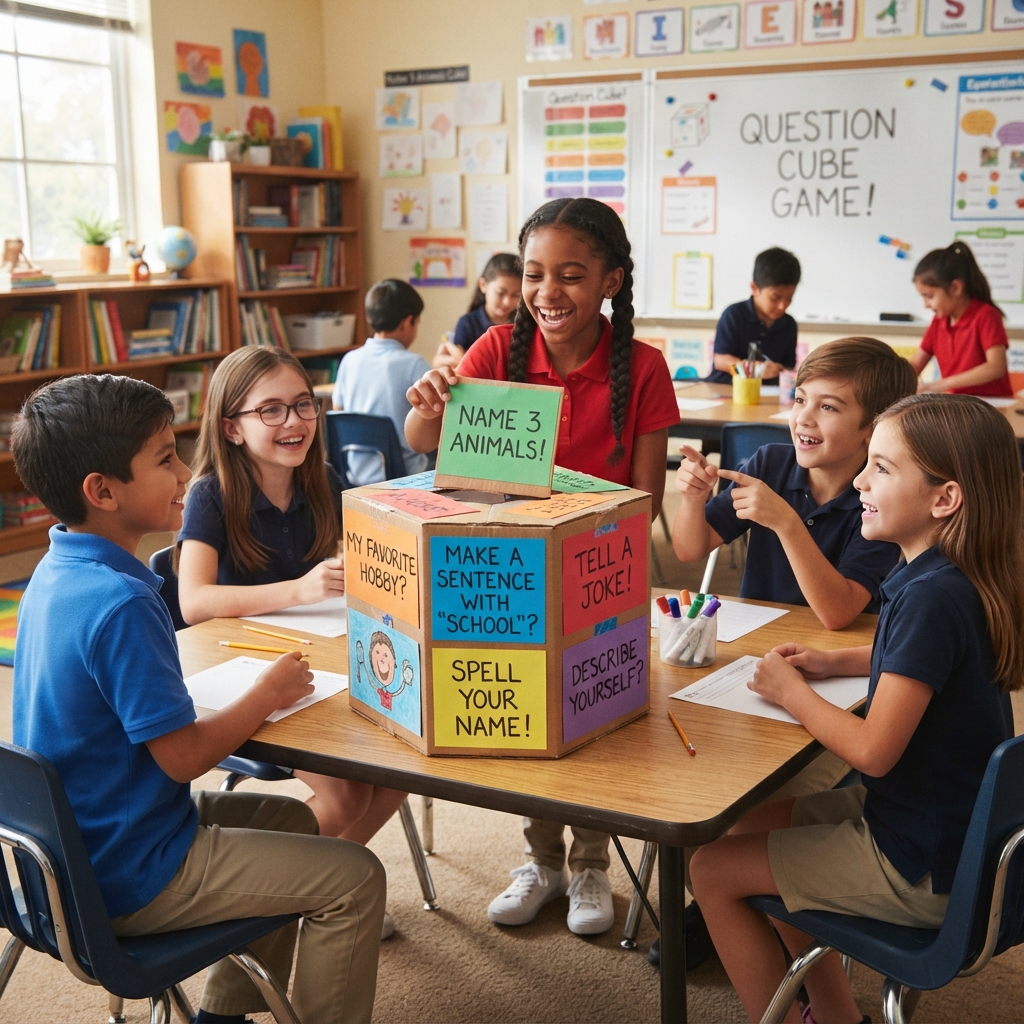
A school question cube is a simple but exciting educational craft that can turn ordinary classroom questions into an interactive learning game. Made from cardboard, paper, or other recycled materials, the cube can contain questions, tasks, challenges, vocabulary words, or discussion prompts on its different sides. Students can roll the cube and answer the question that appears on top. This makes learning more active, social, and enjoyable.
The school question cube can be used for many subjects and age groups. It can help children practice reading, mathematics, science, languages, general knowledge, and communication skills. Teachers can also use it as an icebreaker at the beginning of the school year or as a review activity before a test. Because it is easy to make and customize, the question cube can become a useful classroom tool.
What Is a School Question Cube?
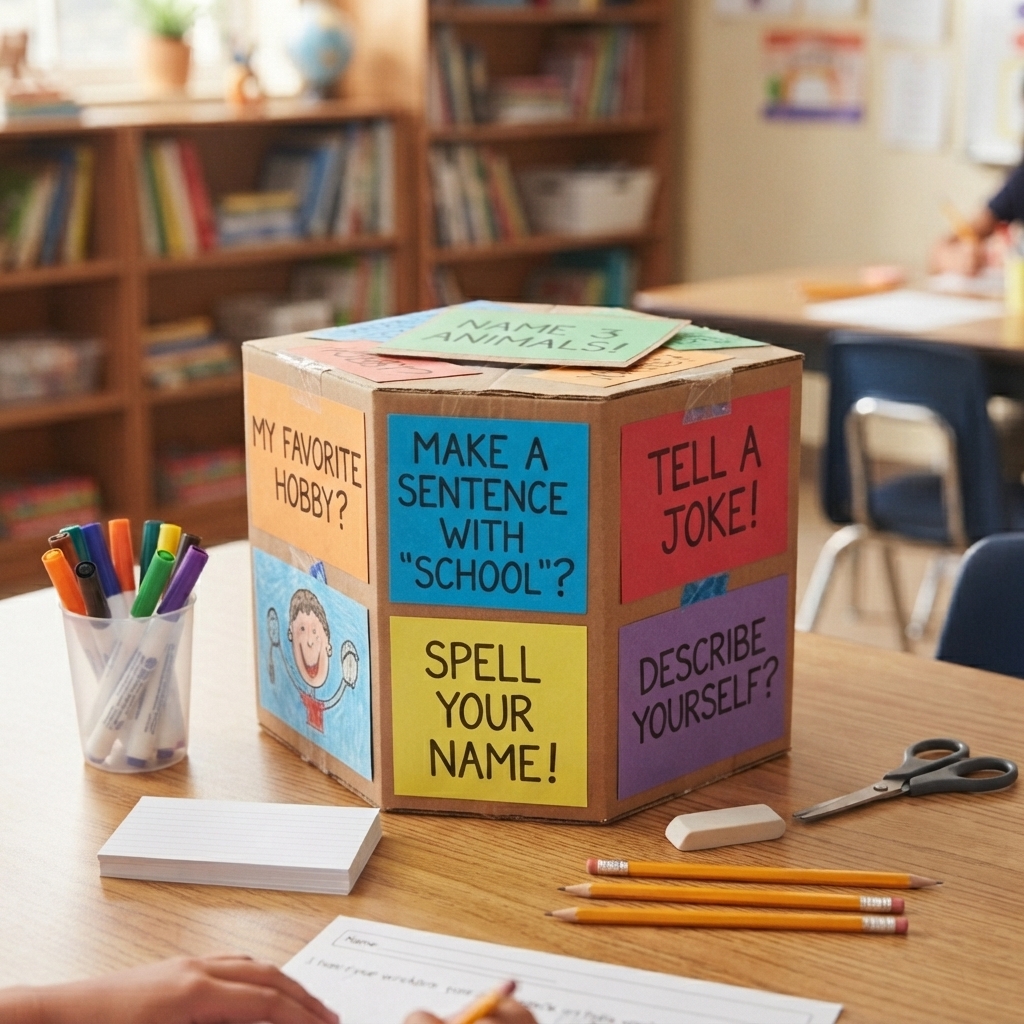
A school question cube is a three-dimensional cube designed for educational activities. Each of its six sides can contain a different question or instruction. Students roll the cube and complete the task shown on the upper side.
For example, a language-learning cube might have questions such as:
- What is your favorite book?
- Name three animals.
- Make a sentence with the word “school.”
- Spell your name.
- Name five colors.
- Describe your classroom.
A mathematics cube could contain simple calculations, while a science cube could ask students to identify animals, plants, planets, or natural phenomena.
The cube can be small enough to hold in one hand or large enough for a whole classroom to see.
Why Make a Question Cube?
The main purpose of a school question cube is to make learning interactive. Traditional worksheets can be useful, but students sometimes become bored when they complete the same type of activity repeatedly.
A question cube introduces an element of surprise. Students do not know which question they will receive until the cube is rolled.
This can encourage curiosity and attention. Students also have an opportunity to speak, think, and participate instead of simply writing answers.
The cube can be especially useful for group activities because students can take turns rolling it and answering questions.
Materials Needed
Making a school question cube does not require expensive materials. The main material can be thick cardboard from an old box.
Other useful materials include colored paper, white paper, glue, scissors, a ruler, a pencil, markers, and tape.
Optional decorations include stickers, crayons, colored pencils, glitter, ribbon, or small paper shapes.
Recycled cereal boxes and packaging can be excellent sources of cardboard.
Using recycled materials also teaches children that everyday objects can be transformed into useful educational resources.
Designing the Cube
Before cutting the cardboard, it is important to plan the cube.
A simple cube template consists of six equal squares connected together. Five squares can form a cross-like arrangement, with another square attached to one side.
Small tabs should be added along some edges. These tabs allow the cube to be glued together.
A ruler should be used to make the squares as equal as possible. Accurate measurements will help the cube close correctly.
Children can draw the template on cardboard or print a cube template on paper and use it as a guide.
Cutting and Folding
Once the template has been drawn, the cardboard can be carefully cut along the outside lines.
The folding lines should not be cut. Instead, they should be gently scored or folded.
The tabs should be bent inward.
Glue can then be applied to the tabs, and the sides can be joined together.
Children should allow the glue to dry before using the cube.
Younger children may need help with cutting and assembling the cardboard.
Decorating the Cube
After the basic cube has been constructed, it can be decorated.
Each side can have a different color. Bright colors can make the cube attractive and easy to use.
Large numbers from one to six can also be placed on the sides.
A title such as “Question Cube” or “Learning Cube” can be written on the top.
Children can add stars, pencils, books, school bags, letters, or numbers as decorations.
However, the questions should remain large and easy to read.
Writing Questions on the Cube
The most important part of the project is choosing appropriate questions.
Questions should match the age and learning level of the students.
For younger children, questions can be short and simple. Older students can receive questions requiring explanations, reasoning, or discussion.
Teachers can write questions directly on the cube or attach removable cards.
Using removable cards is useful because the questions can be changed whenever a new lesson begins.
A Reading Question Cube
A reading cube can help children develop comprehension skills.
Each side can contain a question about a story they have read.
For example:
Who is the main character?
Where does the story happen?
What problem does the character have?
How does the story end?
What was your favorite part?
What lesson did you learn?
Students can roll the cube after reading a story and answer the question that appears.
This encourages them to think more deeply about what they have read.
A Vocabulary Cube
A vocabulary cube is useful for language lessons.
Each side can contain a different vocabulary task.
One side might say, “Define the word.”
Another might say, “Use the word in a sentence.”
Another could ask, “Give an opposite.”
Another might ask, “Give a synonym.”
Students can then roll the cube and complete the task using a vocabulary word chosen by the teacher.
This method helps students understand words rather than simply memorizing their definitions.
A Mathematics Cube
Mathematics teachers can create a question cube containing calculations and mathematical challenges.
For younger children, the cube might contain addition, subtraction, multiplication, and comparison questions.
For example:
Solve 8 + 7.
What is 20 − 6?
Name a shape with three sides.
What number comes after 49?
Older students can use fractions, percentages, geometry, algebra, and word problems.
The cube can be combined with flashcards so that the student rolls the cube first and then answers a problem related to the selected category.
A Science Question Cube
Science is another excellent subject for the cube.
Questions can focus on animals, plants, space, weather, the human body, or the environment.
For example, a science cube might ask:
Name three planets.
What do plants need to grow?
Name an animal that lives in water.
What causes rain?
Name three parts of a plant.
Why is the Sun important?
Students can discuss their answers with classmates.
A Foreign Language Cube
A question cube can also support foreign-language learning.
For beginners, the cube can contain basic questions such as:
What is your name?
How old are you?
What is your favorite color?
Name three animals.
Count from one to ten.
Say a greeting.
Students can practice speaking in a relaxed environment.
This can improve vocabulary, pronunciation, listening, and confidence.
A Back-to-School Question Cube
The cube is especially useful during the first days of a new school year.
Teachers can create questions that help students get to know one another.
Questions might include:
What is your favorite subject?
What do you like to do after school?
What is your favorite book?
What are you excited to learn this year?
What is your favorite hobby?
What would you like to become in the future?
Students can sit in a circle and take turns rolling the cube.
This creates a friendly atmosphere and encourages communication.
Using the Cube in Groups
The school question cube works particularly well in small groups.
Students can sit together around a table. One student rolls the cube and answers the question.
The next student then takes a turn.
The teacher can award points for correct answers or thoughtful responses.
However, competition is not necessary. The main goal can simply be participation and learning.
Group activities also encourage students to listen to one another.
Creating a Team Game
For a more competitive version, students can be divided into teams.
Each team takes turns rolling the cube.
A correct answer earns one point. A difficult question might be worth two points.
The teacher can keep track of the score on the board.
At the end, the team with the highest score wins.
The game should remain friendly and positive so that students do not become discouraged by incorrect answers.
Using Multiple Cubes
Teachers can make several cubes for different purposes.
One cube can contain vocabulary tasks, another can contain mathematics questions, and another can contain discussion prompts.
Students can roll two cubes to create a more complex activity.
For example, one cube might select a vocabulary word while the second cube selects a task such as “define,” “spell,” or “use in a sentence.”
This creates many possible combinations.
Educational Benefits
The school question cube provides several educational benefits.
First, it encourages active participation. Students must listen, think, and respond.
Second, it develops communication skills. Many questions require students to explain their ideas.
Third, it can improve memory because information is practiced in a playful context.
The activity also develops social skills because students take turns, listen to classmates, and respect different answers.
Developing Creativity
Making the cube itself encourages creativity.
Students can choose the colors, decorations, shapes, and themes.
They can also write their own questions.
For example, after studying a science chapter, students can create questions for one another.
This transforms students from passive learners into active participants in the lesson.
Recycling and Environmental Awareness
The school question cube can be made from recycled cardboard.
Old packaging, cereal boxes, and shipping materials can be reused instead of thrown away.
This teaches students that recycling is not only about putting materials into recycling bins. It can also involve creatively reusing objects.
The project therefore combines education with environmental awareness.
Safety Considerations
Children should use scissors carefully and follow classroom safety rules.
Adults should assist with cutting thick cardboard when necessary.
Glue should be used in a well-organized workspace.
The finished cube should have smooth edges so that students can handle it comfortably.
If the cube is made very large, it should be lightweight enough for children to roll safely.
Conclusion
A school question cube is a simple but powerful educational craft. With cardboard, paper, glue, and markers, students can create an interactive learning tool that can be used for many different subjects.
The cube can contain reading questions, vocabulary challenges, mathematics problems, science facts, foreign-language prompts, or personal questions for getting to know classmates. It can be used individually, in pairs, or as a team game.
Its greatest strength is its flexibility. Teachers can change the questions whenever they want, making the cube useful throughout the school year. Students can also help design and decorate it, giving them a sense of ownership over the learning activity.
The project develops more than academic knowledge. It supports communication, creativity, problem-solving, teamwork, confidence, and active participation.
Most importantly, the school question cube shows that learning can be both educational and enjoyable. A simple cardboard cube can become a tool for asking questions, sharing ideas, practicing important skills, and creating positive classroom experiences. Whether used for a lesson, a review activity, a back-to-school game, or a creative school project, the question cube is a small object with many possibilities.