An educational number wheel is a simple, creative, and interactive learning tool that can help children practice numbers and basic mathematics. Made from cardboard, paper, or other inexpensive materials, a number wheel can turn ordinary math exercises into an enjoyable hands-on activity. Children can spin the wheel, discover a number, and complete a mathematical task based on what they see.
The educational number wheel can be used at home, in a classroom, or as part of a school craft project. It can help children learn counting, addition, subtraction, multiplication, division, number recognition, greater-than and less-than comparisons, and even simple fractions. Because the wheel can be customized, teachers and parents can adapt it to different ages and learning levels.
What Is an Educational Number Wheel?
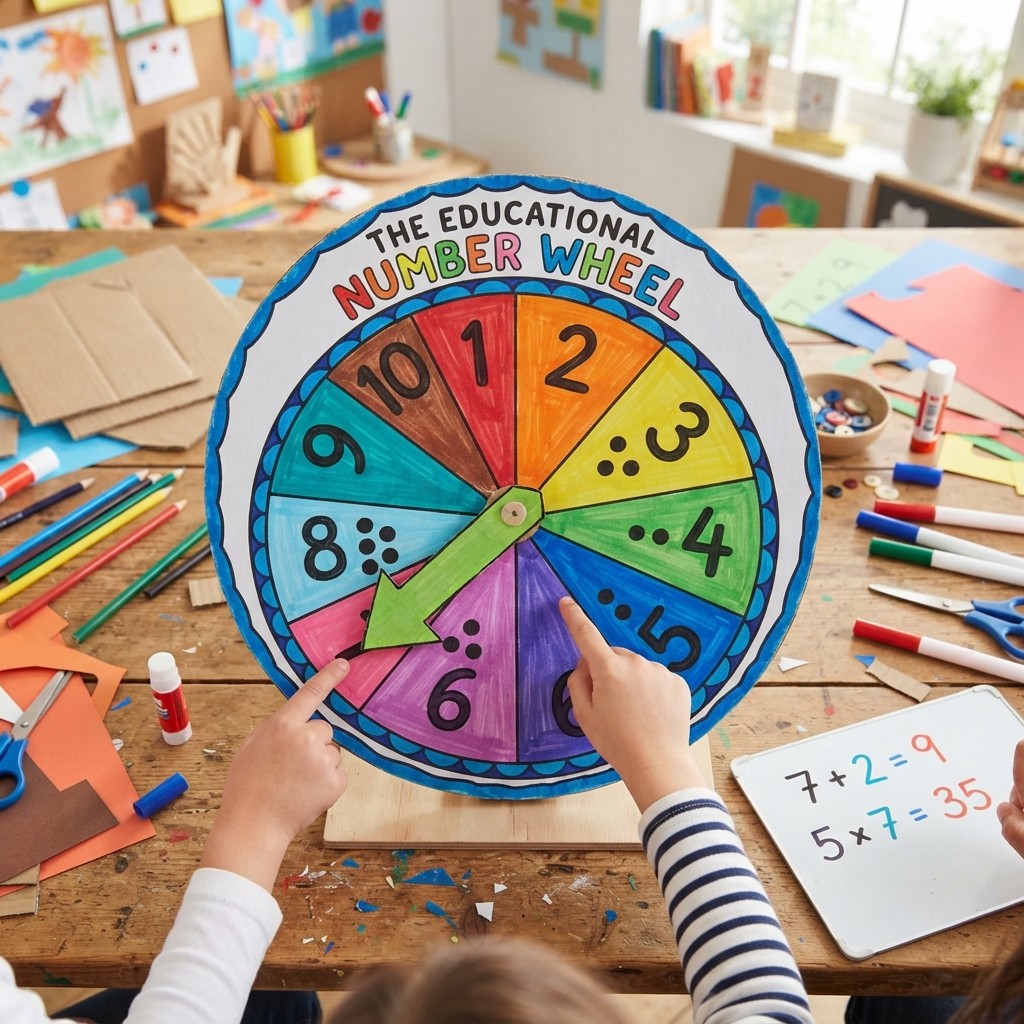
An educational number wheel is a circular learning tool divided into sections containing numbers, mathematical symbols, questions, or instructions. A movable pointer can be attached to the center. When the wheel is spun, the pointer stops on one section, selecting a number or activity.
For young children, the wheel might contain numbers from one to ten. For older learners, it could contain larger numbers, multiplication problems, fractions, or mathematical challenges.
The number wheel turns learning into a small game. Instead of simply reading a list of numbers, children interact with the material by spinning, observing, thinking, and answering.
Why Make a Number Wheel?
Mathematics is an important school subject, but some children may find it difficult or repetitive. A number wheel can make practice more engaging.
The element of chance adds excitement. Children do not know which number they will get, so each turn becomes a small surprise.
The wheel can also provide repeated practice without feeling like a traditional worksheet. A child can spin the wheel many times and receive a different task each time.
Because it is reusable, the same wheel can be used for many lessons.
Materials Needed
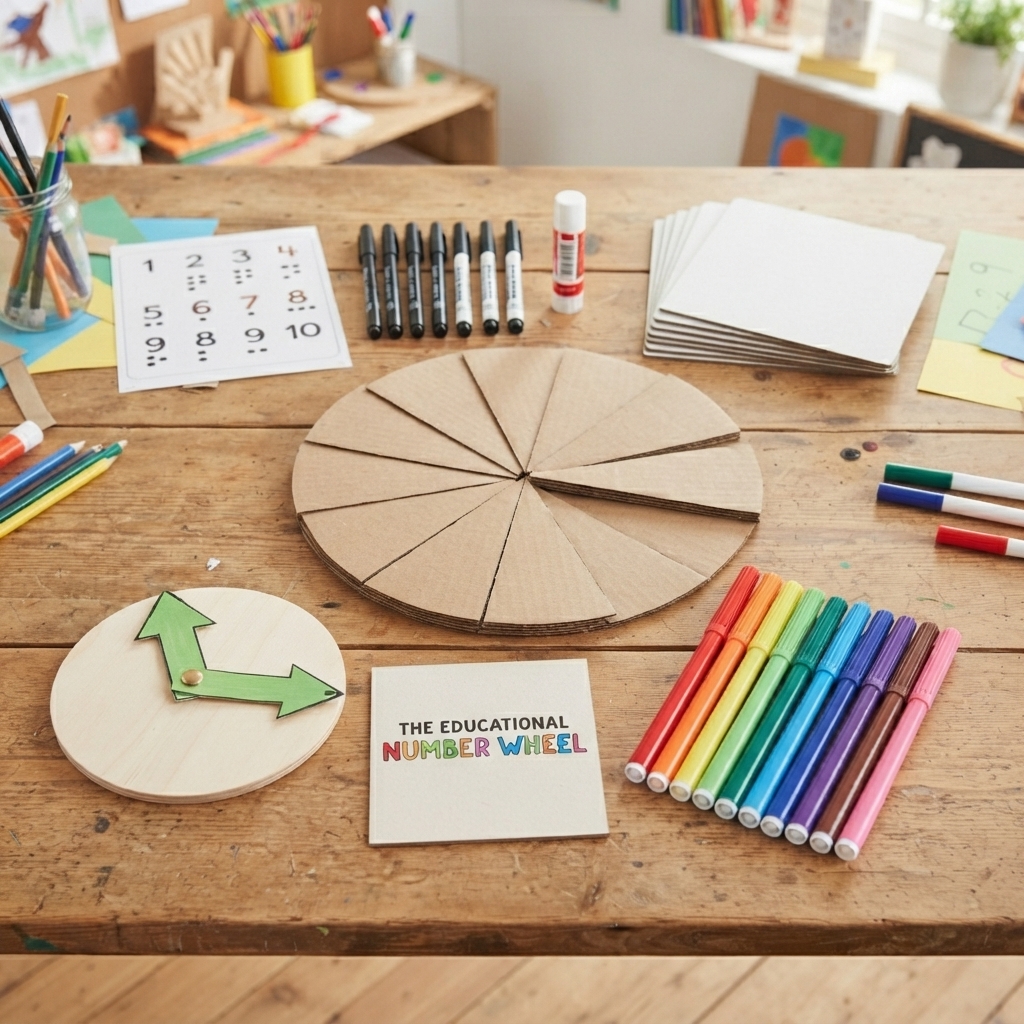
A basic educational number wheel requires only a few materials.
The main material is a piece of cardboard. Recycled cereal boxes or packaging can work well.
Other materials include colored paper, a pencil, a ruler, scissors, glue, markers, and a small piece of cardboard for the pointer.
A paper fastener can be used to attach the pointer to the center of the wheel.
Optional materials include stickers, crayons, colored tape, and transparent adhesive film.
These simple materials make the project affordable for families and classrooms.
Designing the Wheel
The first step is deciding what the wheel will teach.
A beginner’s number wheel can contain numbers from 1 to 10.
A counting wheel might contain numbers from 1 to 20.
A multiplication wheel could contain multiplication facts such as 2 × 3, 4 × 5, and 6 × 7.
Teachers should choose the content according to the students’ current learning level.
The wheel can be divided into equal sections using a ruler and pencil.
Drawing the Circle
A large circle can be drawn on cardboard using a compass or a round plate as a guide.
The circle should be large enough for the numbers to be easily read.
After drawing the circle, lines can be drawn from the center toward the outer edge to divide it into sections.
For example, a wheel with eight sections will have eight different learning areas.
The sections can be colored differently to make the wheel attractive.
Adding Numbers
Numbers should be written clearly inside each section.
For a beginner wheel, the sections might contain:
1, 2, 3, 4, 5, 6, 7, and 8.
A more advanced wheel could contain larger numbers.
Large, bold numbers are easier for young children to recognize.
Different colors can be used to separate groups of numbers, but the design should remain easy to read.
Making the Spinner
The spinner is the part that points to the selected number.
A simple pointer can be cut from cardboard.
It can be shaped like a long arrow with a pointed end.
A hole should be made near the opposite end of the pointer.
Another hole should be made in the center of the wheel.
A paper fastener can connect the pointer to the wheel.
The pointer should be loose enough to rotate freely.
Children can decorate the pointer with their favorite colors.
A Counting Number Wheel
The simplest version of the educational number wheel is a counting wheel.
Children spin the pointer and say the number aloud.
They can then count objects that correspond to that number.
For example, if the pointer lands on five, the child can count five pencils, five blocks, or five paper shapes.
This helps connect written numbers with real quantities.
An Addition Wheel
An addition wheel can contain numbers instead of questions.
A student spins the wheel twice.
The first number is the first part of the equation, and the second number is the second part.
For example, the student might spin 4 and then 3.
The student must solve:
4 + 3 = 7
This is a simple way to practice mental mathematics.
A Subtraction Wheel
The same idea can be used for subtraction.
Students spin twice and subtract the smaller number from the larger one.
For example, if they get 9 and 5, they solve:
9 − 5 = 4
This activity can help children practice subtraction while also learning to compare numbers.
A Multiplication Wheel
Older children can use the wheel for multiplication practice.
Each section can contain a multiplication fact.
For example:
2 × 4
3 × 6
5 × 7
8 × 4
The student spins the wheel and solves the problem.
Teachers can create separate wheels for different multiplication tables.
A wheel focused only on the 2, 5, or 10 times tables can be useful for beginners.
A Division Wheel
Division problems can also be included.
The wheel might contain problems such as:
12 ÷ 3
20 ÷ 4
30 ÷ 5
36 ÷ 6
Students spin the wheel and calculate the answer.
The problems should match the students’ abilities.
Greater Than and Less Than
A number wheel can help children understand mathematical comparisons.
The teacher can ask students to spin the wheel twice.
The student compares the two numbers and decides whether the first number is greater than, less than, or equal to the second.
For example:
8 > 5
or
3 < 7
This makes an abstract mathematical concept more interactive.
Even and Odd Numbers
The number wheel can also teach even and odd numbers.
When the pointer lands on a number, the student must identify whether it is even or odd.
The student can explain the answer.
For example, 8 is even because it can be divided into pairs without anything left over.
The teacher can make the activity more challenging by asking students to find another even or odd number on the wheel.
Number Recognition
For young learners, simply recognizing numbers is an important skill.
The teacher can spin the wheel and ask the child to say the number aloud.
The child can then write the number on a small whiteboard or piece of paper.
Pictures can also be added to the wheel to help children connect numbers with quantities.
Number Words
An advanced version can combine numbers and written number words.
For example, one section might show the numeral 7, while another contains the word seven.
Children can match the numeral with its written form.
This is particularly helpful for young children learning to read number words.
Using the Wheel for Fractions
Older students can use a number wheel to practice fractions.
The sections can contain fractions such as:
1/2
1/3
1/4
3/4
Students can identify which fraction is larger or smaller.
They can also be asked to convert simple fractions into decimals or percentages when appropriate for their level.
A visual fraction wheel can include colored sections to make the concept easier to understand.
Creating a Mathematics Challenge Wheel
A more advanced wheel can contain different types of mathematical tasks.
For example, one section might say “Add,” another “Subtract,” another “Multiply,” and another “Compare.”
A second wheel can contain numbers.
Students spin both wheels to determine their challenge.
This creates many different combinations and prevents the activity from becoming repetitive.
Using the Wheel in a Classroom
The number wheel can be placed at the front of a classroom or on a mathematics activity table.
Students can take turns spinning it.
The teacher can ask the selected student to solve the problem aloud.
Other students can check the answer.
This creates an opportunity for students to learn from one another.
The wheel can also be used during short review sessions at the beginning or end of a lesson.
Team Games
The educational number wheel can become a team game.
Students can be divided into small groups.
Each team takes a turn spinning the wheel and solving the selected problem.
A correct answer earns a point.
The team with the most points at the end wins.
The teacher should make sure that the competition remains friendly and that students are encouraged to help one another.
Using the Wheel at Home
Parents can use a number wheel to practice mathematics with their children.
A short five-minute game can be included in a daily learning routine.
Children can spin the wheel while preparing homework or during a family learning activity.
Because the wheel is reusable, parents do not need to prepare a new worksheet every time.
It can simply be stored in a box and used whenever practice is needed.
Educational Benefits
The educational number wheel provides several important benefits.
It encourages active learning because children physically interact with the learning material.
It develops number recognition, calculation skills, concentration, and memory.
The wheel also encourages children to solve problems independently.
Repeated practice can help build confidence in mathematics.
Because the activity feels like a game, children may be more willing to practice skills that they previously found difficult.
Developing Fine Motor Skills
Making and using the wheel can also develop fine motor skills.
Children practice drawing circles, cutting cardboard, attaching the spinner, and writing numbers.
Spinning the pointer requires controlled hand movement.
These small physical actions support coordination and concentration.
Encouraging Creativity
Children can design their own number wheels.
They can choose colors, decorations, themes, and questions.
One child might create a space-themed wheel with planets around the outside.
Another might create an animal-themed wheel with cartoon animals beside the numbers.
Allowing children to participate in the design process gives them a sense of ownership.
Recycling Benefits
Using recycled cardboard is another advantage.
Old boxes can be transformed into educational tools instead of being thrown away.
Children learn that recycling can involve creativity and practical use.
The project can also encourage discussions about reducing waste and using resources responsibly.
Safety Tips
Children should use scissors carefully and according to their age.
Adults should help with cutting thick cardboard when necessary.
The paper fastener should be attached securely so that it does not become loose.
Small pieces should be kept away from very young children.
The finished wheel should have smooth edges so it can be handled safely.
Conclusion
An educational number wheel is a simple and effective learning tool that can make mathematics more interactive and enjoyable. With cardboard, paper, markers, glue, and a simple rotating pointer, children can create a reusable activity for practicing numbers and mathematical concepts.
The wheel can be adapted for counting, addition, subtraction, multiplication, division, number comparison, even and odd numbers, number words, fractions, and many other topics. It can be used at home, in the classroom, or as part of a school craft exhibition.
The project offers benefits beyond mathematics. Children develop fine motor skills while making the wheel, improve concentration while playing, and develop problem-solving skills while answering questions. They can also practice teamwork and communication during group games.
The best feature of the educational number wheel is its flexibility. A teacher can change the questions according to the lesson, while students can create their own designs and challenges.
Most importantly, the number wheel demonstrates that learning mathematics can be creative and enjoyable. A simple piece of recycled cardboard can become an interactive tool that encourages children to count, calculate, compare, think, and discover. With imagination and careful design, a small number wheel can make a big difference in the way children experience mathematics.